
More and more users in the plastics processing industry are asking themselves:
Does a cleaning granulate or a cleaning concentrate have the lower Product Carbon Footprint (PCF)?
The answer: Cleaning concentrate performs significantly better in terms of PCF.
Manufacture: Cleaning concentrate vs. cleaning granules
A cleaning concentrate consists of carefully selected substances that dissolve deposits from metal surfaces. Cleaning granules, on the other hand, are based on a polymer to which these substances are added. The energy-intensive production of this polymer means that the product carbon footprint of cleaning granules is significantly higher than that of a concentrate.
Faster, material-friendly cleaning saves energy and manpower
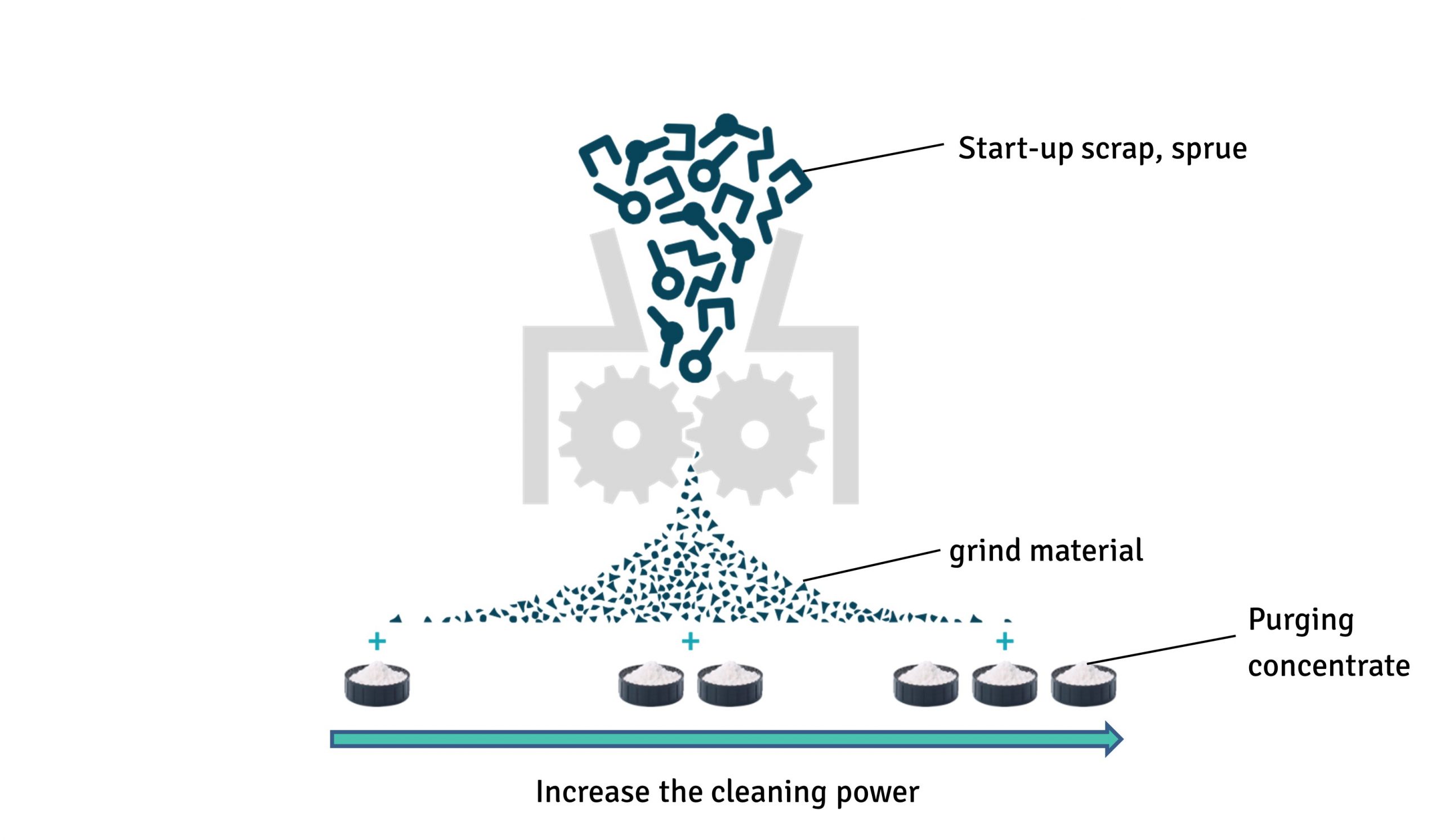
The more complex polymer production process is just one factor contributing to the higher CO₂ emissions of cleaning granules. A cleaning concentrate can significantly speed up the cleaning process, which further reduces the Product Carbon Footprint. Cleaning power is simply increased by adding more powdered concentrate to the granules or regrind as required. This increased cleaning power enables faster and gentler cleaning, whilst saving energy and labour costs.
Using regrind delivers double the CO₂ savings
Another advantage of the low-carbon cleaning concentrate is the option to use regrind. Only a powdered concentrate can be mixed with regrind. For example, start-up scrap can be ground up and used together with the cleaning concentrate to clean machines and tools. This reduces CO₂ emissions in two ways: the start-up scrap does not need to be disposed of, and there is no need to use virgin material.
Reduced transport requirements further lower CO₂ emissions
The lower Product Carbon Footprint of a cleaning concentrate is also evident during transport: 1 kg of concentrate can be used to produce up to 200 kg of cleaning granules. Instead of whole pallets, it is sufficient to transport small containers measuring 13 x 13 x 20 cm and weighing just 1.2 kg. A clear advantage for the carbon footprint.
Conclusion: An environmentally friendly and resource-efficient cleaning process is only possible with a cleaning concentrate. Please get in touch with us.